

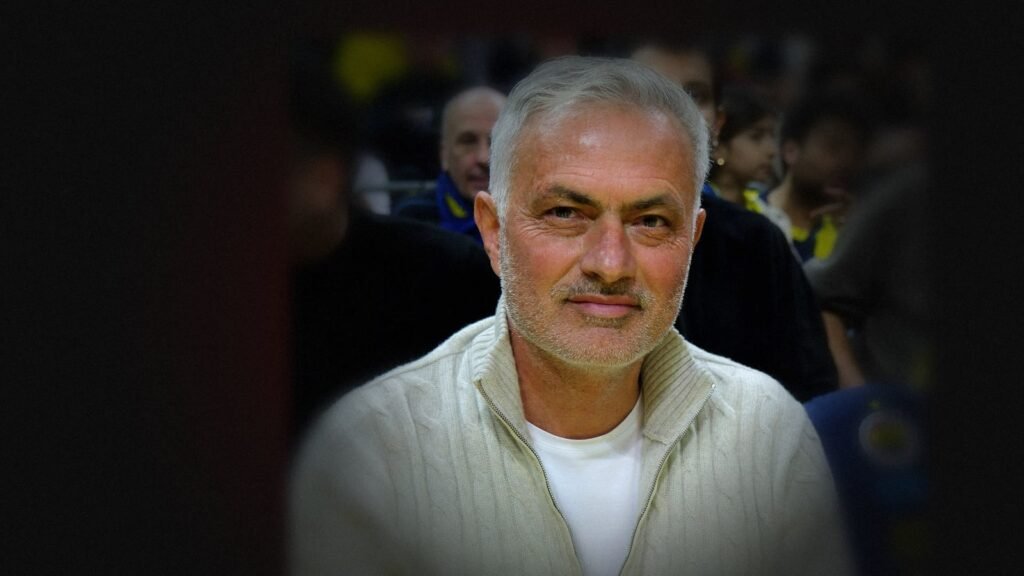
Two minutes from time, Jude Bellingham spun away from his man and found Arda Güler. Güler slipped Eduardo Camavinga into the space Barcelona always leave behind them, Camavinga went past Pau Cubarsí, and the cutback found Kylian Mbappé. Barcelona 1-2 Real Madrid, and Barcelona’s perfect start in the league is over.
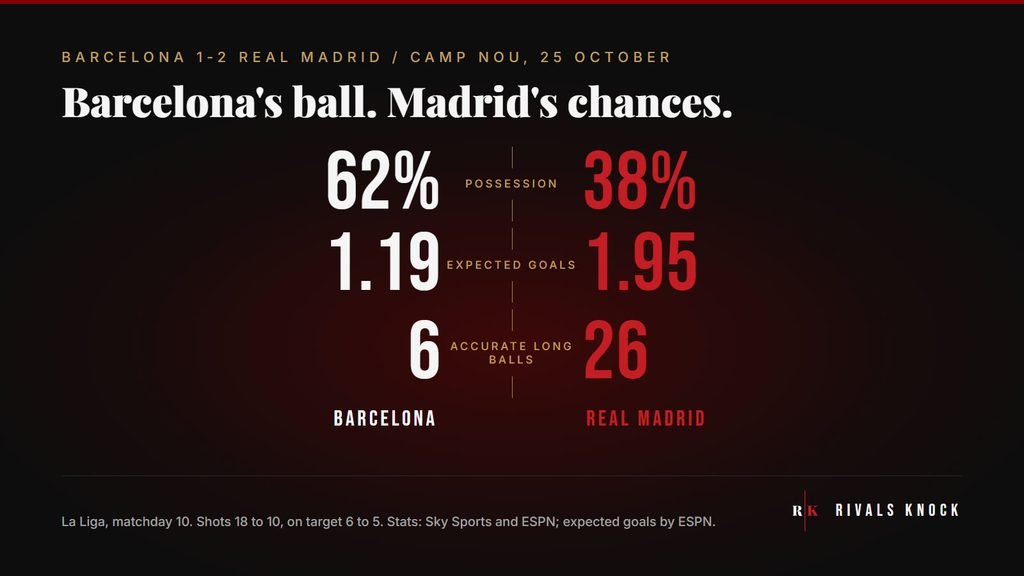
They had won nine from nine, and on Sunday they had 62 percent of the ball. They still lost, because José Mourinho had worked out where the door was, and his players spent ninety minutes waiting to walk through it.
Embed from Getty ImagesGetty 1 of 5: Flick greets Mourinho before kick-off (Lluis Gene / AFP via Getty Images).
The Night in Three Goals
The first goal had luck in the finish, and nobody in white should pretend otherwise. On 41 minutes Yan Diomandé drove a low cross in from the left, Gerard Martín’s clearance hit Mbappé, and the ball went in off his thigh. But a lucky finish is not the same as a lucky attack. Arda Güler had already gone close twice, and Madrid kept finding Diomandé running at a defence without Jules Koundé, which had lost Xavi Espart to injury after half an hour. Before half-time Diomandé hit the side netting one-on-one.
Barcelona’s reply was the best football of the night. Lamine Yamal missed from close range two minutes after the opener, and on 61 minutes Pedri found Raphinha, the league’s top scorer, who beat Andriy Lunin low across goal. From there Barcelona pushed. Lunin saved a Gerard Martín header from a corner, and Yamal’s shot bounced just wide with twelve minutes left.
Embed from Getty ImagesGetty 2 of 5: Cucurella against Lamine Yamal (Lluis Gene / AFP via Getty Images).
Then came the change that won it. With ten minutes left Mourinho took off Bernardo Silva and sent on Camavinga, because the game needed, in his words, “players with fresh legs to continue marking and counterattacking.” Minutes later Camavinga was the one running past Cubarsí. Afterwards Mourinho could not resist a dig: “There are coaches who, when they want to make changes, look at the bench and don’t have solutions. I have a rich bench.”
Embed from Getty ImagesGetty 3 of 5: Camavinga with Joan García and Cubarsí, the winner move (David Ramirez / Soccrates / Getty Images).
Barcelona had the ball. Madrid had the plan. On a night like this, the plan wins.
How Mourinho Picked the Lock
Barcelona’s high line is built to beat exactly the run Mbappé likes most. In Mbappé’s first Clásico against Hansi Flick’s Barcelona, he was caught offside seven times, the most by any player in a major European league in six years, according to Sky Sports.
Mourinho explained the answer himself: “When attackers go deep, they’re often offside or the goalkeeper is positioned to cover that space. If the movement in depth comes from the second line, as Camavinga did for the goal and as Bellingham did in that two-on-one situation, it’s much harder for the opponent.”
That is the lock, picked. A defender can hold his line against a forward standing on his shoulder. He cannot easily track a midfielder who starts deep and arrives at full speed. Mourinho also praised the courage to play out from the back “against an opponent that presses a lot”, and when the press came, they went long and early: 26 accurate long balls to Barcelona’s six.
The other half of the plan was on Madrid’s left. Marc Cucurella spent the night on Lamine Yamal, who, Mourinho said, “tried everything to get Cucu a yellow card”, while Diomandé tracked back so often that Espart and Cancelo rarely got the two-against-one they wanted. By ESPN’s expected goals measure, Madrid had the better chances, 1.95 to 1.19.
And they had a goalkeeper who was not supposed to play. Thibaut Courtois was ill, so Lunin started and made five saves. Mourinho’s message to him before kick-off was simple: “You train to play, not to sit on the bench. Go and play.”
Mourinho, Then and Now
His first Clásico at the Camp Nou, in November 2010, ended 5-0 to Pep Guardiola’s Barcelona. Seventeen months later, in April 2012, his Madrid won 2-1 there on the way to a league title with a hundred points. In his first spell he won five of seventeen Clásicos.
Those Madrid sides won big games with aggression, pressing and Cristiano Ronaldo running at tired legs. This one won with patience and timing: long spells without the ball, then midfielders arriving where nobody was looking. Same coach, same stadium, a different key. And he has won the first Clásico of his second spell.
Barcelona’s Bad Week
This was Barcelona’s second defeat in five days, after the 4-2 in Paris, and Flick’s first words afterwards were about tiredness: his side lacked freshness. He mentioned the hours stuck on a plane in Seville, then refused to hide behind them: “I don’t accept excuses.” Pedri was just as honest: in the first half, he said, Barcelona were not themselves.
It would be lazy to call this a crisis. Barcelona are still top on 27 points, with Atlético on 25 and Madrid on 24. They have Lamine Yamal, Pedri and Rodri, and a squad that won nine league games in a row before this week.
But Sky’s Adam Bate asked the right question on Monday morning: do Barcelona have a problem in big games? The issue is not the high line itself, which won them nine in a row. It is whether the pressure on the ball holds when the legs are tired, and this week it did not. The injury list is growing too. Espart went off, Pedri finished with a sore ankle, and Raphinha asked to come off before the end.
What My 2-2 Got Wrong, and Right
In my preview I called it 2-2. It finished 1-2, so the score was wrong. I also said nobody would quite manage to finish the job. Madrid did.
The story was closer. I wrote that Barcelona would arrive tired, that Madrid would sit in a 4-4-2 and wait for one pass behind the line, and that if anyone won it, it would be the side that defended the last twenty minutes better. Barcelona had their best spell after the equaliser and could not turn it into a second goal. Madrid held, then took their chance.
The Verdict
Real Madrid deserved it. Not because they were better with the ball, because they were not, but because they knew exactly what they wanted to do without it and did it for ninety minutes. Mbappé’s winner was his 100th goal for the club in his 116th game, and it came at the end of a move built to beat Barcelona’s best idea.
Embed from Getty ImagesBarcelona fans will point at the deflection for the first goal. Madrid fans will point at João Cancelo’s studs into Diomandé’s leg, which Mourinho called “a clear red card” missed by a VAR “that was asleep in the 60th minute.” Both complaints are fair, and neither changes who made the better chances.
Mourinho’s own line is the right one: “Real Madrid doesn’t play to win at Camp Nou. Real Madrid plays to win championships.” He was already thinking about Racing on Sunday: “If we win today and lose at El Sardinero, today’s victory doesn’t hold the same weight.”
Keep it in proportion. One night does not prove Barcelona’s system is broken. It proves the system can be beaten by a team that prepares for it. What changed is the gap: a Barcelona win would have made it nine points, and it is three. For the first time this season, Barcelona look catchable.
Embed from Getty ImagesYour turn. Pick your side.
The debate
No arguments yet. Start one.
Argue hard, respect the other side. Attack the argument, never the person. Comments that cross that line get removed.