

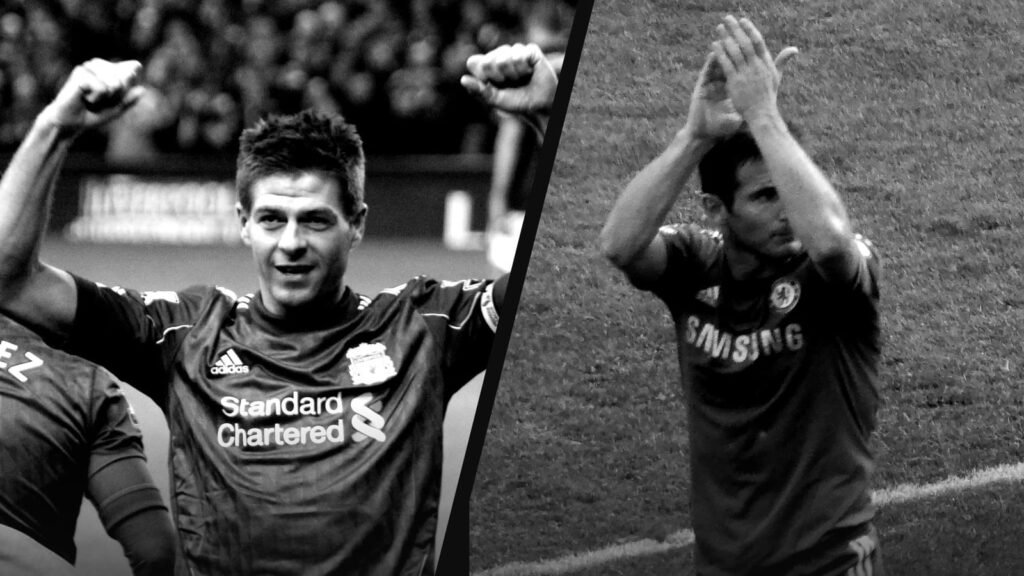
For about ten years, every England manager was asked the same question, and none of them found an answer. Gerrard or Lampard? And if the answer is both, how?
It sounds like a luxury problem. Two world-class central midfielders from the same country, at the same time, both in their prime. Most nations would give anything for one. England had two and spent a decade looking worse for it.
I watched this debate from the outside, as a Real Madrid fan with the Premier League on every weekend. That helps. I have no club reason to lean either way. So let me try to answer the question England never could.
Two Men, Two Clubs, One Position
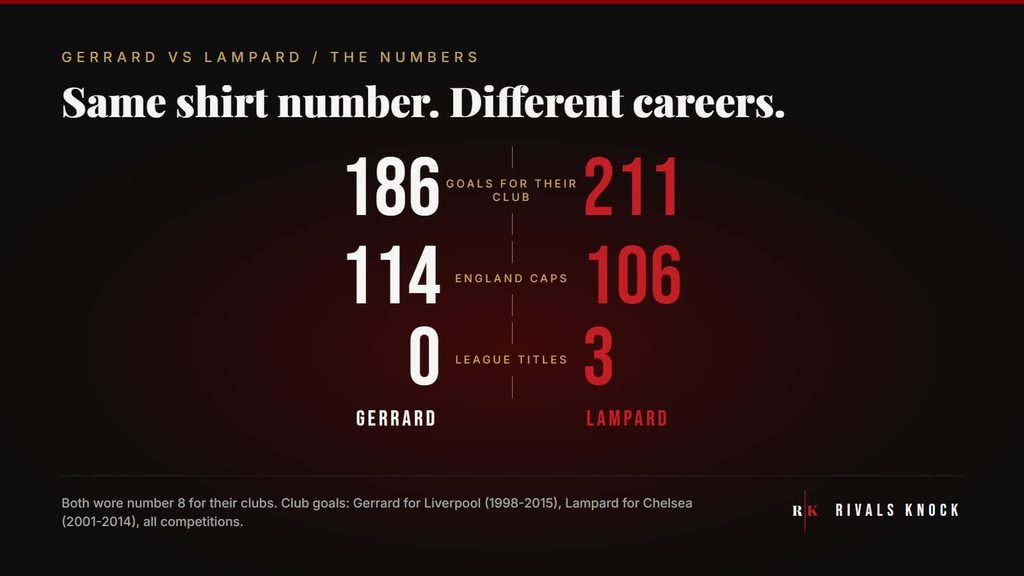
Gerrard came through Liverpool’s academy and made his debut in 1998. He never really left. He became captain in October 2003 and stayed at Anfield until 2015, playing 710 games and scoring 186 goals. He was the heartbeat of a club that spent most of his career chasing the league it never won.
Lampard grew up at West Ham, where his father, a club legend, was assistant manager and his uncle, Harry Redknapp, was the manager. Some supporters said he was only in the team because of his family. He answered by moving to Chelsea in 2001 and becoming something nobody had predicted: the greatest goalscoring midfielder in Premier League history.
They played the same position in very different ways. Gerrard was a storm. Long passes that switched the play across the whole pitch, tackles that lifted the stadium, shots from thirty yards that felt like they could go through the net. Lampard was a clock. He arrived in the box at exactly the right second, again and again, season after season. Gerrard made the impossible look possible. Lampard made the difficult look routine.
What Gerrard Did
If you want one night to understand Gerrard, it has to be Istanbul, May 2005. Liverpool were 3-0 down to AC Milan at half-time in the Champions League final. Gerrard headed the first goal back in the fifty-fourth minute and waved his arms at the crowd as he ran back. Liverpool scored three times in six minutes and won on penalties. He was named man of the match.
A year later came the 2006 FA Cup final against West Ham. Liverpool were losing 3-2 in stoppage time when Gerrard hit a shot from more than thirty yards that flew into the bottom corner. They won on penalties again. People still call it the Gerrard Final.
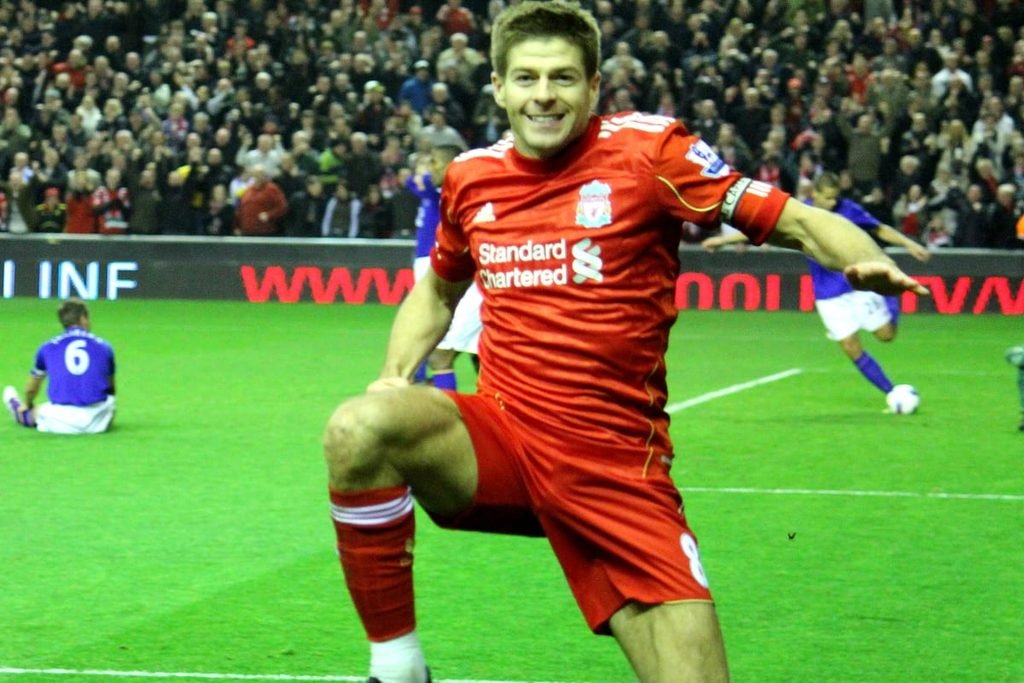
He won the Champions League, the UEFA Cup, two FA Cups and three League Cups. He finished third in the Ballon d’Or in 2005. What he never won was the league, and the closest he came still hurts. In April 2014, with Liverpool top of the table, he slipped in a home game against Chelsea, Demba Ba ran through to score, and the title went to Manchester City. Football does not always reward the people who give it the most.
Gerrard made the impossible look possible. Lampard made the difficult look routine.
What Lampard Did
Lampard’s numbers are almost ridiculous for a midfielder. He scored 211 goals for Chelsea, more than any player in the club’s history, strikers included. His 177 Premier League goals are the most by a midfielder. Between 2001 and 2005 he played 164 Premier League matches in a row, a record for an outfield player.
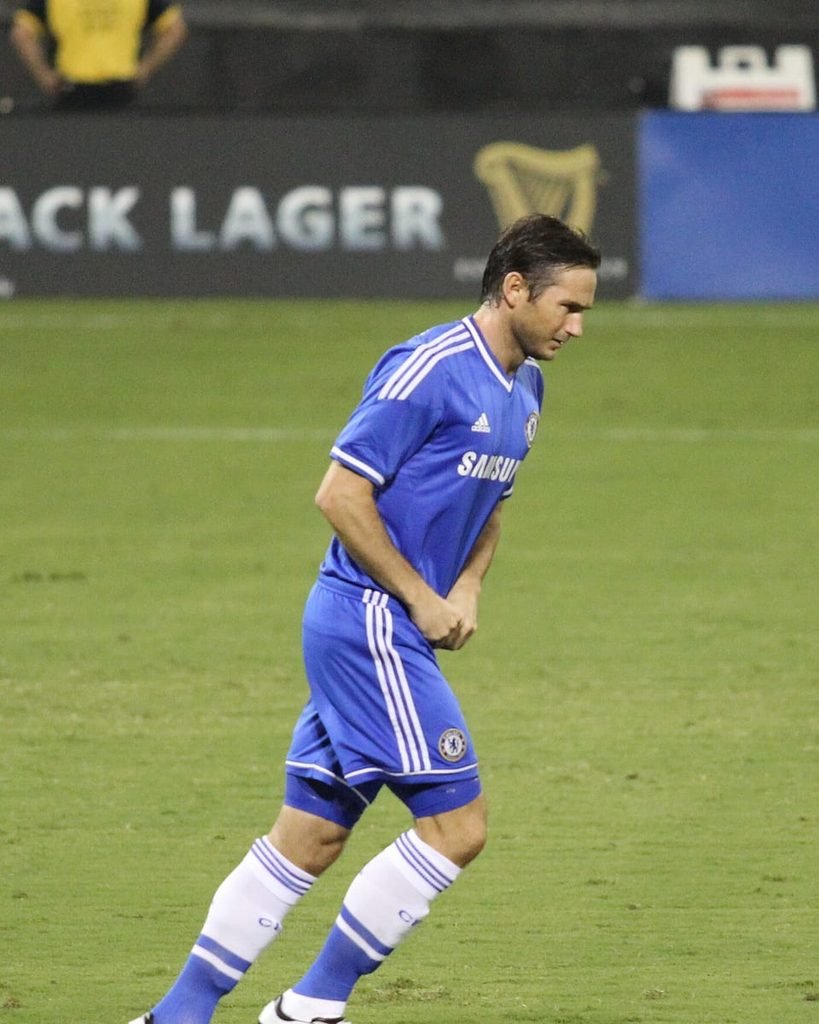
He won three Premier League titles, four FA Cups, two League Cups, the Europa League and, in 2012 in Munich, the Champions League, wearing the captain’s armband because John Terry was suspended. In 2005 he finished second in the Ballon d’Or, ahead of Gerrard in third.
And there is one night that tells you who he was as a man. In April 2008, days after his mother died, he took a penalty against Liverpool in the Champions League semi-final at Stamford Bridge. He scored, knelt, and pointed to the sky. Gerrard was on the pitch that night. Nobody in that stadium, in either colour, begrudged him that goal.
Why England Never Solved It
The problem was never that one of them was not good enough. It was that both of them were the same kind of great.
Sven-Göran Eriksson played them side by side in a flat 4-4-2 at Euro 2004 and for much of the 2006 World Cup. Both wanted to get forward. Neither wanted to sit. At their clubs, each had a team built around him, with a Makélélé or a Xabi Alonso doing the dirty work behind. For England, they took turns doing a job that suited neither of them, and the team lost its shape. Later managers moved Gerrard to the left, or dropped one of them, or tried a diamond. Nothing lasted.
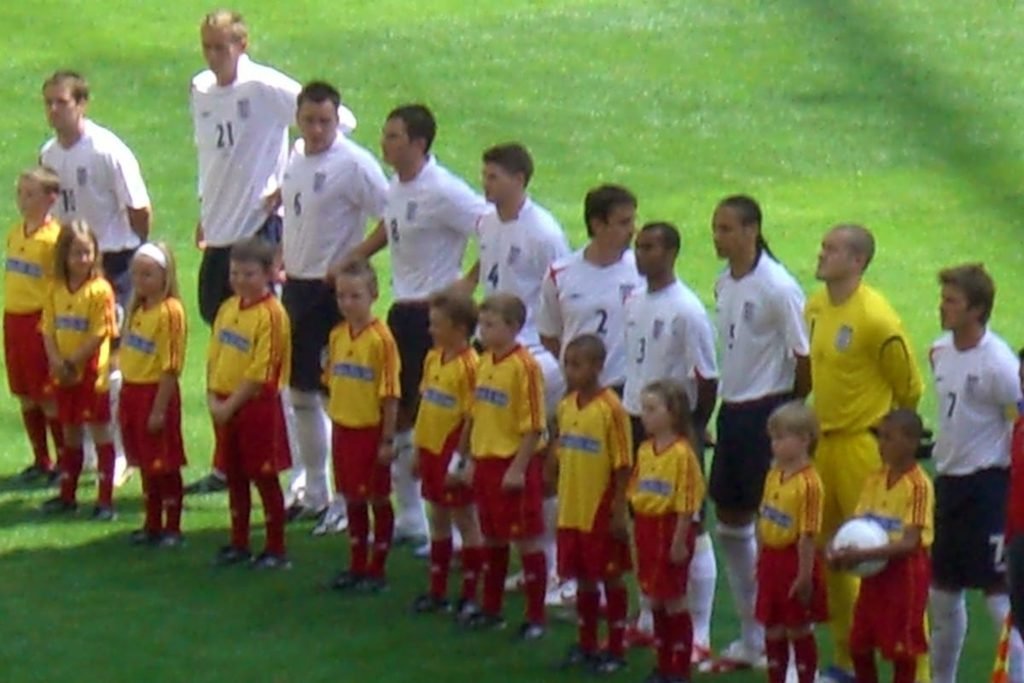
Nobody talks about this enough. Paul Scholes, a midfielder many rated above both of them, was pushed out to the left wing to fit them in, and he retired from England at twenty-nine. England did not have a Gerrard problem or a Lampard problem. They had a planning problem.
Then there was Bloemfontein in 2010. England were 2-1 down to Germany in the World Cup when Lampard hit a shot that bounced off the bar and a clear yard over the line. The goal was not given. Germany won 4-1. That goal is a big part of why football finally brought in goal-line technology. It came too late for him.
The Verdict: Gerrard or Lampard?
So, one or the other. I pick Gerrard.
Lampard had the better career, and I do not think that is close. More goals, more trophies, a league title three times over, and a Champions League as captain. He did it all with a consistency that no midfielder in English football has matched. He deserves every word of praise he gets, and more than he got as a young player at West Ham.
But Lampard played in the best Chelsea team ever assembled, with Drogba, Terry, Makélélé and Mourinho. Gerrard spent most of his career dragging Liverpool sides that were not good enough to where they had no right to be. Istanbul does not happen without him. The 2006 FA Cup does not happen without him. If you took Lampard out of that Chelsea team, it was still a very good team. If you took Gerrard out of that Liverpool team, it was ordinary.
That is my answer. Gerrard was the better footballer. Lampard was the better career. And the question England should have asked was never which one. It was who could play behind them both.
Your turn. Pick your side.

The debate
No arguments yet. Start one.
Argue hard, respect the other side. Attack the argument, never the person. Comments that cross that line get removed.