

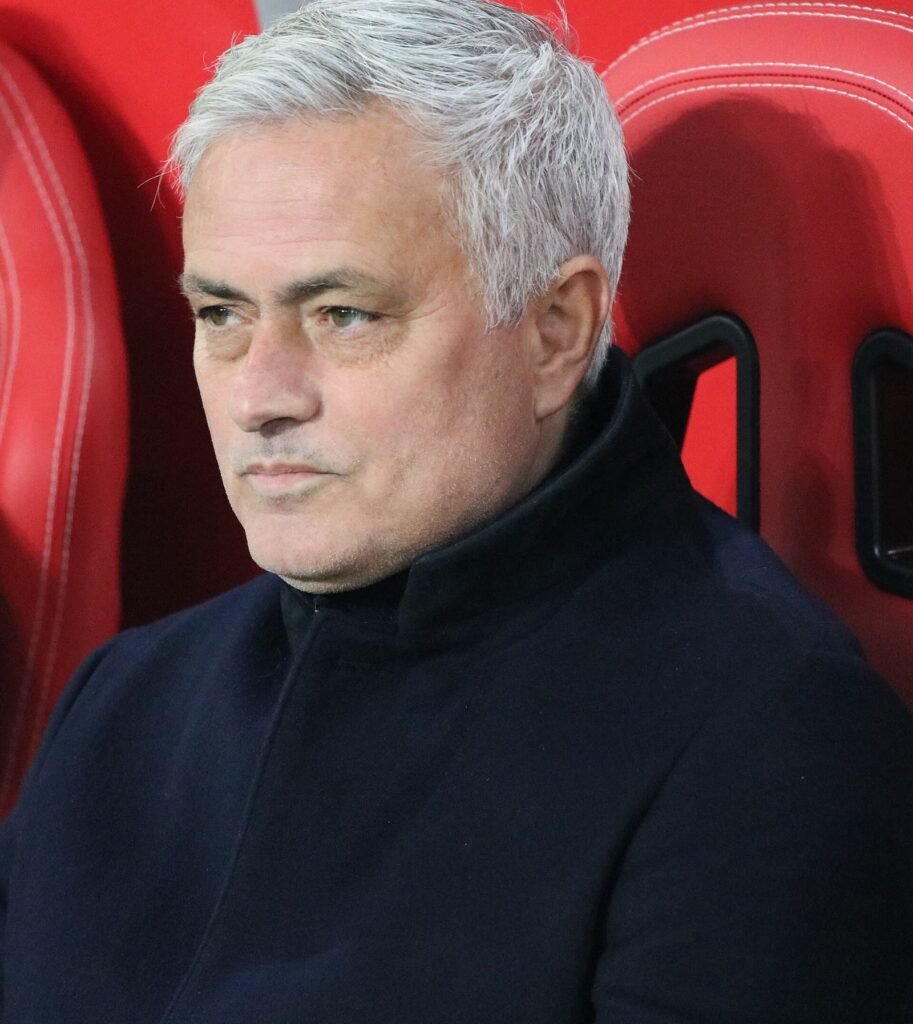
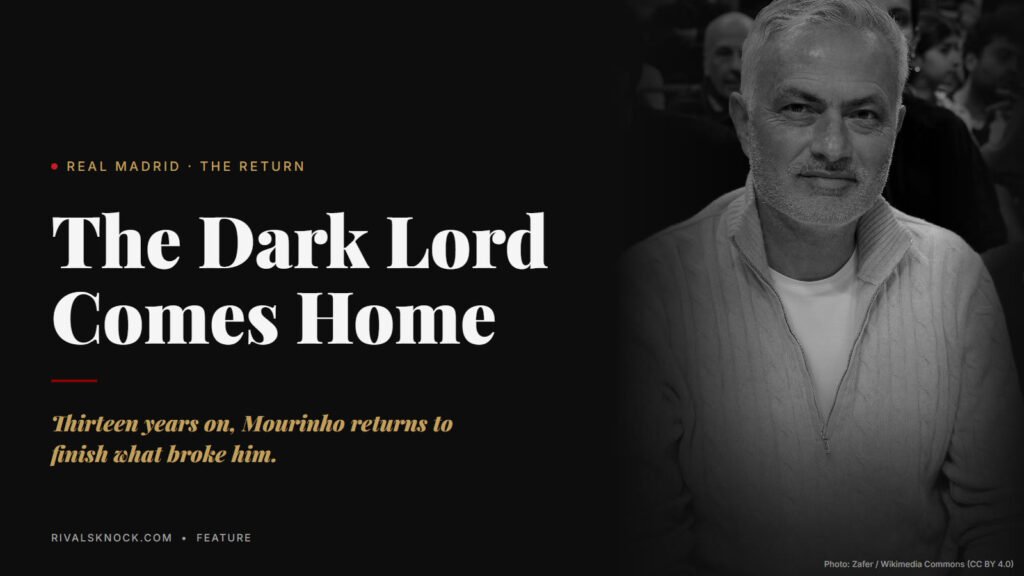
Mourinho returns to Real Madrid thirteen years after he left it. A version of Jose Mourinho lives in grainy footage from 2004 and 2010, and if you have watched it recently, you will understand why a certain kind of football fan never stopped believing in him. It is the man sprinting down the touchline at Old Trafford in a grey overcoat. It is the man sprinting across the Camp Nou pitch, finger raised, while the Barcelona ground staff turn the sprinklers on him in fury. It is the translator nobody rated, who turned himself into the most feared manager on the continent through sheer refusal to accept the place the game had assigned him.
That man is coming back to Real Madrid. And to understand why this matters, why it is not just another managerial appointment, you have to understand what Real Madrid did to him the first time, and what he did to prove he never needed their permission to be great.
Before Madrid, He Made Himself Immortal
The thing people forget when they reduce Mourinho to a defensive cynic is that he did the single hardest thing in club football. Twice. From the outside.
He won the Champions League with Porto in 2004. A Portuguese club, with a fraction of the budget of the giants, with players nobody outside Portugal could name. He stood in his first press conference and told the room this team would win it, and they laughed, and then he did it. He beat Manchester United on the way, at Old Trafford, with a last-minute goal that sent him running down that touchline into English football’s imagination forever. He beat Deportivo. He dismantled Monaco in the final. A team that had no business winning it, winning it, because he built them into something more than the sum of their parts.
Then he did it again with Inter in 2010, and this time it was not just improbable. It was a masterpiece.
The Most Beautiful Defeat of His Career
If you want to know who Mourinho really is, you look at the Camp Nou, April 2010. The semi-final. His Inter against Pep Guardiola’s Barcelona, the greatest club side of the modern era, on their own pitch, needing to protect a lead.
Thiago Motta got sent off early. Mourinho played the rest of the night with ten men against the best attacking team the sport had produced in a generation. And they held. Every soul in blue and black defending like their lives depended on it, because for that man, they did. Samuel Eto’o, a striker who had won the treble at that very club a year earlier, ran himself into ruin as an emergency full-back. Marco Materazzi in tears at the final whistle. Mourinho tearing across the pitch to celebrate as Barcelona, humiliated, turned on the sprinklers to drive him off.
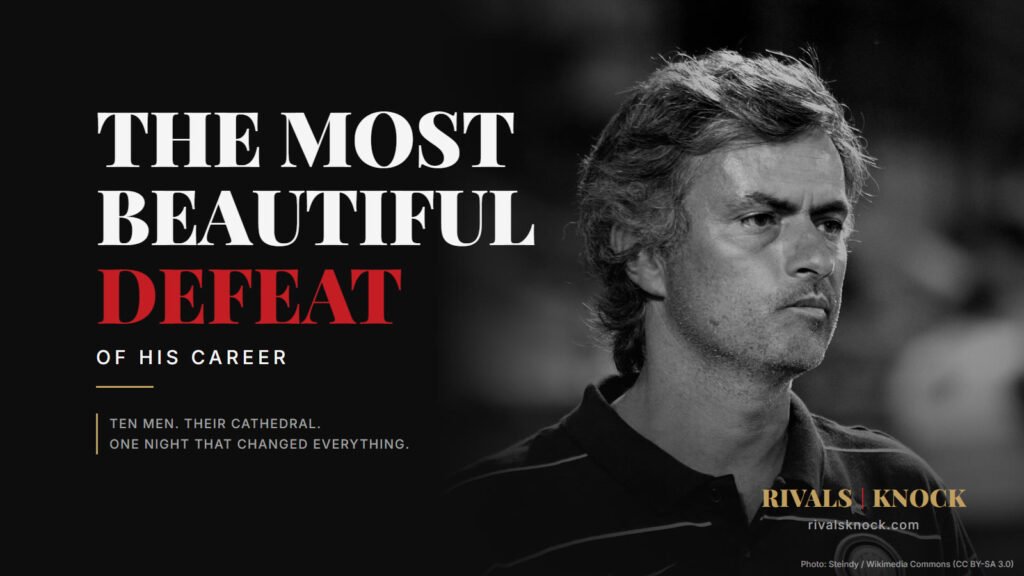
He later called it the most beautiful defeat of his career. He lost the match on the night and won the tie, and in doing so he detonated the myth that Guardiola’s Barcelona were football’s moral and sporting superiors. He proved they could be beaten, and he proved it in their cathedral, with ten men, as the manager they had once rejected.
Because that is the part that turned a great manager into the Dark Lord. Barcelona had a choice years earlier. Mourinho, who had won them nothing yet but carried a Champions League and a UEFA Cup from Porto and two Premier League titles from Chelsea, or Pep Guardiola, who had managed their reserve team for one season. They chose Pep, because Pep was one of them and Jose, the translator, the outsider, never would be. Barcelona did not simply reject a manager. They created an enemy.
If they were going to play with the ball, he would play without it. If they were going to entertain, he would make sure nobody enjoyed a single minute against him ever again. He did not just want to beat Barcelona. He wanted to prove that the club who decided he was not worthy had made the mistake of their lives.
Madrid Came for the Anti-Barcelona
So when Real Madrid came for him in 2010, fresh off the treble at Inter, it made a terrible kind of sense. Barcelona had a stranglehold on Spanish and European football. Guardiola’s side were rewriting what the game could look like. And Real Madrid, the most successful club in the history of the sport, could not live with being second in their own country to the men from Catalonia.
They hired the one manager on earth who had already proven he could break Guardiola. They hired the anti-Barcelona in human form.
And here is what nobody says clearly enough. He did it.
The Real Madrid that Mourinho built in 2011-12 finished with 100 points. A record. They scored 121 goals. Cristiano Ronaldo hit the peak of his powers under him. That team did not just win La Liga, they took it off the greatest Barcelona side ever assembled, ending a run that had made Madrid feel small in their own kingdom. In his first Clásico, in November 2010, Barcelona beat his Madrid 5-0, a night so complete it felt like a humiliation with no answer. Eighteen months later, Mourinho was the answer. He dragged Real Madrid back to Barcelona’s level by force of will when nobody else could.
He built that machine. Remember that, because it matters for how the story ends.
The One Thing the Bernabéu Demands
But the Champions League never came. And at Real Madrid, the Champions League is not a trophy. It is the reason the club exists.
Three seasons, three semi-finals, three exits. Barcelona in 2011, after a bitter 2-0 night at the Bernabéu. Bayern Munich on penalties in 2012, Ronaldo, Kaká and Ramos all missing from the spot. Borussia Dortmund in 2013. Each one a step from the final, each one falling short at the last wall.
You can read those defeats two ways, and honesty demands we hold both. One reading is that he was desperately unlucky, that the finest margins in football, a penalty shootout against Bayern, separated him from the trophy he was hired to win. The other reading is harder. That the atmosphere he created, the wars with the press, the feuds inside the dressing room, the open conflict with Iker Casillas that split the squad down the middle, left his teams one moment of fragility from the edge. That the same intensity which made him unbeatable over 180 minutes could crack a team when everything came down to a single kick.
Both are true. That is what makes it a tragedy rather than a simple failure. He was the right man. He was so nearly the right man that you can still feel how close it came.
The Dark Lord Was Gone Before the Reward Arrived
And then he left in 2013, exhausted; the relationship with the club and its icons burned down to the studs. Carlo Ancelotti walked in behind him. And the very next season, Real Madrid won La Décima. The tenth European Cup. The trophy the club had chased for twelve years. The trophy Mourinho was hired to deliver.
They won it with his spine. His Ramos, his Ronaldo at the height Mourinho had pushed him to, his Di María, his defensive structure. He built the team that finally ended the wait, and he was gone before the reward arrived. He did the years of hard labour. Someone else lifted the trophy.
No sentence in his career is crueller than that one. He made the Real Madrid that won the Champions League. And the Champions League is the one thing he never won there.
The Dark Lord Returns
So now he comes back. Older, greyer, thirteen years on from the last time he walked into the Bernabéu. And every word above is why this is not just news. It is the closing of a circle that has been open for over a decade.
Real Madrid in 2026 are fractured. Two seasons without a major trophy. Three managers who could not fix it. A dressing room where Tchouaméni and Valverde clashed so badly that both were fined, an atmosphere that has curdled. It is, in other words, exactly the kind of broken thing Mourinho has spent his whole life claiming he was born to fix. Give him a mess, a common enemy, and a group of players who need to be told who they are, and history says he builds something dangerous.
The question that will define his second spell is whether the man who made his name on obsessive control and manufactured conflict still works in a game that has moved on. Whether the players of 2026, raised in a different football culture, will run through the wall for him the way Eto’o and Sneijder and Córdoba once did. Nobody knows. That uncertainty is what makes it compelling.
Where Rivals Knock Stands
Here is our honest position, and it holds two things at once, because the truth about Mourinho always does.
The first spell fell short of the only measure that ultimately counts at Real Madrid. He did not win the Champions League, and at that club, in the end, everything else is a footnote. We will not pretend otherwise.
But the man who could not win it there is the same man who won it twice from the outside, against the odds, against the giants, with teams that had no right. He is not a pretender coming back for a job. He is a genuine legend of this competition returning to the one place that got away, to attempt the one thing his extraordinary career is still missing at its most demanding address.
Real Madrid did not settle for Mourinho in 2010, and they have not settled for him now. They have gone back for the man who once made them believe again, who built the team that went on to conquer Europe, and who never got to stand in the middle of the pitch and lift the trophy he did the work to earn.
The Dark Lord is home. He has unfinished business with the biggest prize in the game, at the one club that broke his heart. If he finishes it this time, there will be no footnote, no cruel twist, no successor lifting what he built. Just Mourinho, immortal one more time, in the only place that ever made him feel mortal.
That is a story worth watching. And whatever you think of him, and there is plenty to argue about, only a fool would bet against a wounded genius with something left to prove.
The debate
No arguments yet. Start one.
Argue hard, respect the other side. Attack the argument, never the person. Comments that cross that line get removed.