

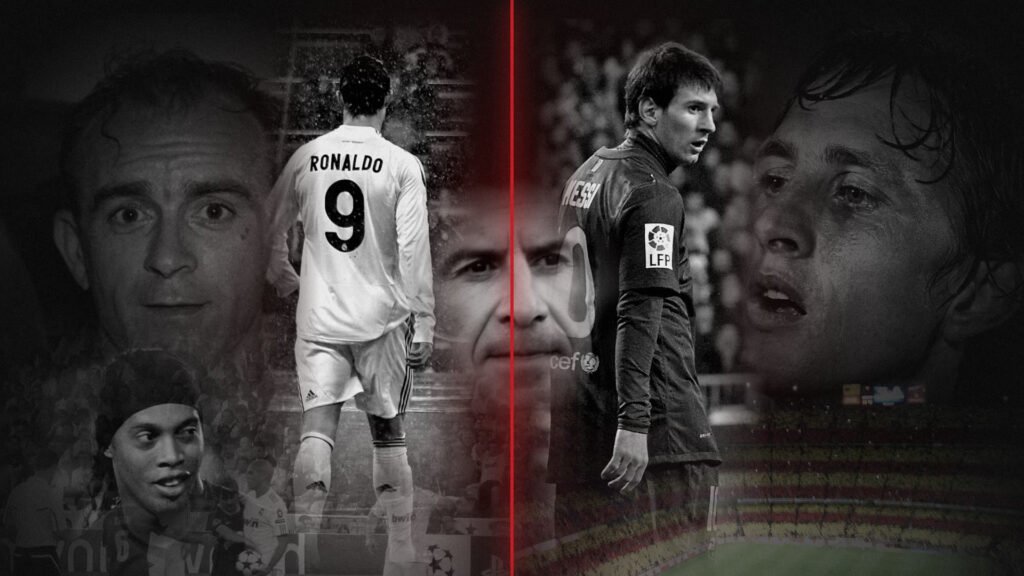
There are bigger stadiums in the world. There are older derbies, louder derbies, fixtures with more goals in them. There is nothing like El Clásico. When Real Madrid and Barcelona walk out of the tunnel, hundreds of millions of people are watching a football match. The other half of the story is older than both trophy cabinets, and it has almost nothing to do with the ball.
I am a Madridista. I have been since before I understood how many arguments that word would start. So let me say something that might surprise you from this side of the line: you cannot understand this rivalry if you only listen to one side of it. Barcelona fans will tell you it is the story of a nation standing up to a dictatorship. Madrid fans will tell you it is the story of the greatest club in history and a neighbour who never forgave it for being great. Both are telling the truth. Neither is telling all of it.
Here’s the thing. El Clásico was never just about football. It was about who gets to say what Spain is.
Two Cities, Two Ideas of a Country
Barcelona came first. The club was founded in 1899 by a group led by Joan Gamper, a Swiss businessman who had fallen in love with the city and wanted it to have a team. Madrid Football Club followed in 1902. The word Real did not arrive until 1920, when King Alfonso XIII gave the club his royal patronage, and with it the crown that still sits on the badge today.
That detail matters more than it looks. One club carried the name of the capital, the seat of the Spanish state and, later, of the crown on its crest. The other belonged to a city with its own language, its own history of governing itself and its own flag. Catalonia had spent centuries arguing with Madrid about who it was. Football simply handed that argument a scoreboard.
They first met in May 1902, at a tournament held to celebrate the coronation of Alfonso XIII. Barcelona won 3-1. Nobody in that crowd could have imagined what they had just started.
The War That Never Left the Stadium
To understand why the feeling runs so deep, you have to go back to 1936. The Spanish Civil War tore the country in half, and Catalonia stood with the Republic against General Francisco Franco. That August, Barcelona’s president, Josep Sunyol, drove into the Guadarrama mountains north of Madrid and straight into territory held by Franco’s soldiers. He was arrested and killed without trial. Barcelona remembers him as a martyr. Most football fans outside Catalonia have never heard his name.
Franco won the war in 1939, and for the next thirty-six years the Catalan language was pushed out of public life. Its institutions were dismantled and its flag was suppressed. There was one place where a Catalan could still shout in his own language, in a crowd of thousands, without standing out. The football ground.
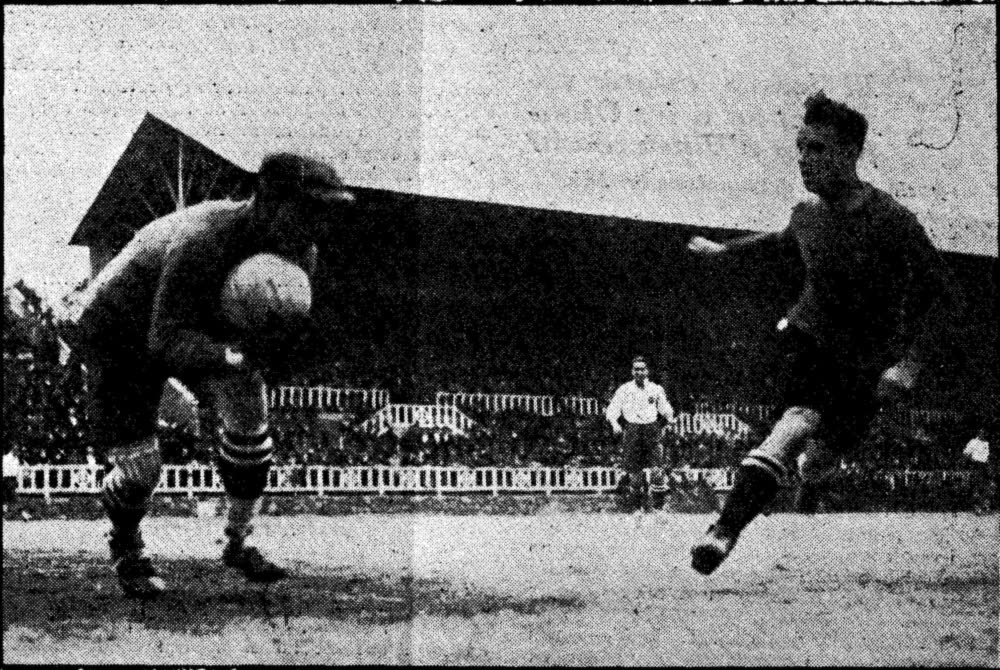
Then came June 1943. Barcelona had beaten Real Madrid 3-0 in the first leg of a cup semi-final. In the second leg in Madrid, Real Madrid won 11-1. Barcelona’s version of that night involves a visit to their dressing room before kick-off by an official of the regime, and players too frightened to compete. Madrid’s version points to a first leg in Barcelona where the home crowd whistled the visitors all night, a Madrid crowd determined to answer it, and a Barcelona side that simply collapsed. Historians still argue about what was said in that dressing room. Nobody argues about the scoreline, or about the fact that Barcelona have never let it go.
Di Stéfano: The Transfer That Changed Everything
If 1943 gave Barcelona its grievance, 1953 gave Real Madrid its dynasty.
Alfredo Di Stéfano was the best footballer in the world who was not yet playing in Europe. Barcelona believed they had signed him, having agreed a deal with River Plate, the Argentine club that held his registration. Real Madrid believed they had signed him too, having dealt with Millonarios of Bogotá, the Colombian club he was actually playing for. A mediator appointed to settle the dispute came up with a solution nobody had seen before or since: he would play alternate seasons for each club. The ruling tore Barcelona apart. Their president resigned, the club sold its half of the deal to Madrid, and Di Stéfano became a Madrid player.
Barcelona fans have always believed the regime tipped the scales. Madrid fans answer that it was Barcelona who sold their share of him, and that no government in history ever scored a goal. What happened next is not in dispute. With Di Stéfano leading the line, Real Madrid won the first five European Cups ever played, from 1956 to 1960. The club Santiago Bernabéu built became the most famous in the world, and Barcelona had to watch the man they thought was theirs do it in white.
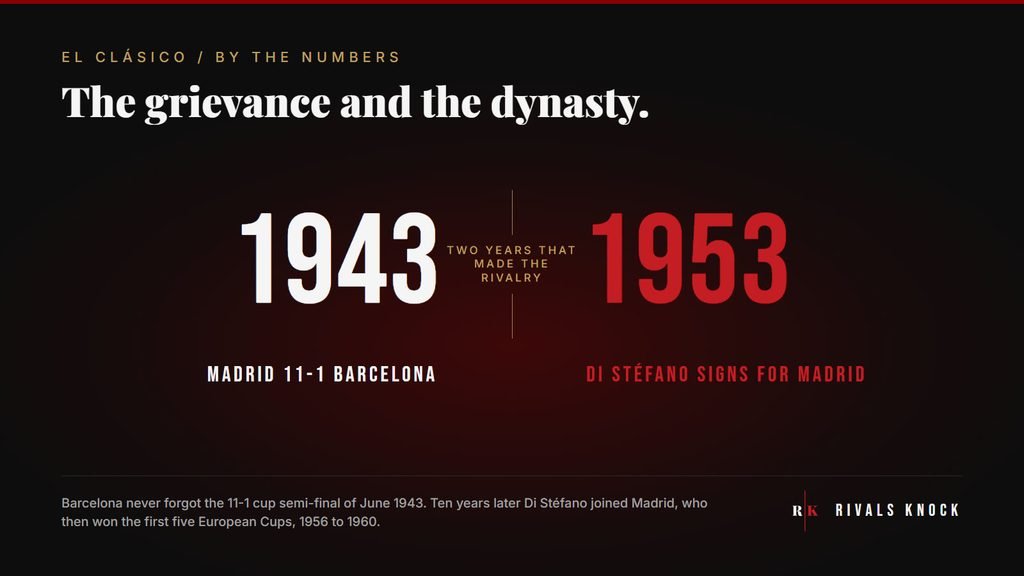
One side got its grievance in 1943. The other got its dynasty in 1953. Both have been living off them ever since.
Més Que Un Club
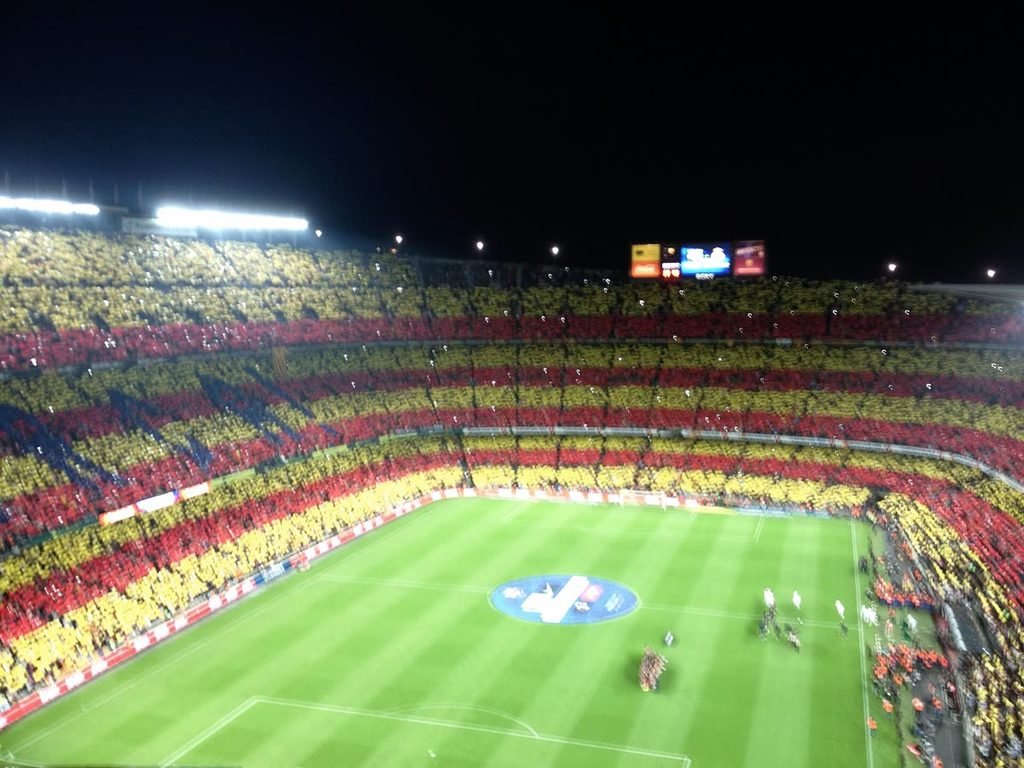
In 1968, Barcelona’s president Narcís de Carreras described the club as more than a club. Més que un club. It became the motto, and it was never just a slogan. Under Franco, the Camp Nou was one of the few places where Catalan identity could gather in the open. Supporting Barcelona was a way of saying something you could not safely say anywhere else.
This is where I have to be fair to my own side, because the story is often told as if Real Madrid were simply Franco’s club. It is not that simple. The regime was happy to bask in Madrid’s European glory, because a winning team in white made Spain look modern to a world that had turned its back on it. But Madrid’s greatness was built by Bernabéu, by Di Stéfano, by Puskás and Gento, not by decree. Madrid suffered in that war too. The city spent two and a half years under siege by Franco’s armies, and the club’s ground at Chamartín was left in ruins. The man who was Madrid’s president when the war broke out, Rafael Sánchez-Guerra, was a committed Republican. He refused to flee as the capital fell, was imprisoned by Franco’s side, and later escaped to Paris to serve in the Republican government in exile. A club does not choose which government stands behind it in the photographs.
Barcelona fans will also point to the referees, and one night above all. In June 1970, in a cup quarter-final at the Camp Nou, referee Emilio Guruceta gave Real Madrid a penalty for a foul that replays suggest happened outside the box. Cushions rained onto the pitch, fans ran on, and the match was abandoned. To Barcelona, it proved everything they believed about who the system protected. To Madrid, it was one bad decision in a tie they already led 2-0 from the first leg. Both readings have survived for more than half a century.
Still, perception is its own kind of truth. To Barcelona, Madrid became the symbol of the centre, of power, of the state. To Madrid, Barcelona became a club that treated every defeat as a political injustice. Both labels stuck, and both clubs have been wearing them ever since.
Cruyff Chooses a Side
In 1973, Johan Cruyff, the best player on the planet, joined Barcelona. Ajax had been talking to Real Madrid, but Cruyff forced the move to Barcelona, and he later said he could never have played for a club so tied to Franco’s regime. The symbolism was perfect. In February 1974, with Franco still alive, Barcelona went to the Bernabéu and won 5-0. For Catalans, it felt like far more than two points.
Cruyff did more than win a match. He came back as coach in 1988 and built an idea of football at Barcelona: possession, patience, the ball as the whole point. The club still defines itself by it. From then on the rivalry was not only about politics. It was about philosophy. Madrid wanted to win. Barcelona wanted to win in a particular way. Each side thought the other’s way was a kind of arrogance, and each side was a little bit right.
Figo and the Pig’s Head
Then came the betrayal. In the summer of 2000, Luís Figo, Barcelona’s captain and their best player, crossed the line. Florentino Pérez, running for the Madrid presidency, had promised the members that Figo would come. He won the election, Real Madrid paid Figo’s release clause, a world-record fee at the time, and Barcelona woke up to see their captain holding a white shirt.
They never forgave him. When Figo went back to the Camp Nou with Madrid in November 2002 and walked over to take a corner, the stands threw everything they had at him. Coins, bottles, lighters. And a pig’s head. The referee took the players off and the match was stopped for more than ten minutes. It remains the most famous image of what this fixture does to people.
As a Madridista, I will say this: Figo was never the villain Barcelona painted. Players move. But I understand exactly why they felt what they felt. That is the rivalry in one sentence. You can believe the other side is wrong and still understand the wound.
When the Whole World Started Watching
The last twenty years turned El Clásico into a global event. In November 2005, Ronaldinho played so beautifully at the Bernabéu that the Madrid crowd stood and applauded him. A Barcelona player, cheered in our house. That is the respect this website is built on, and I have never been prouder of our fans.
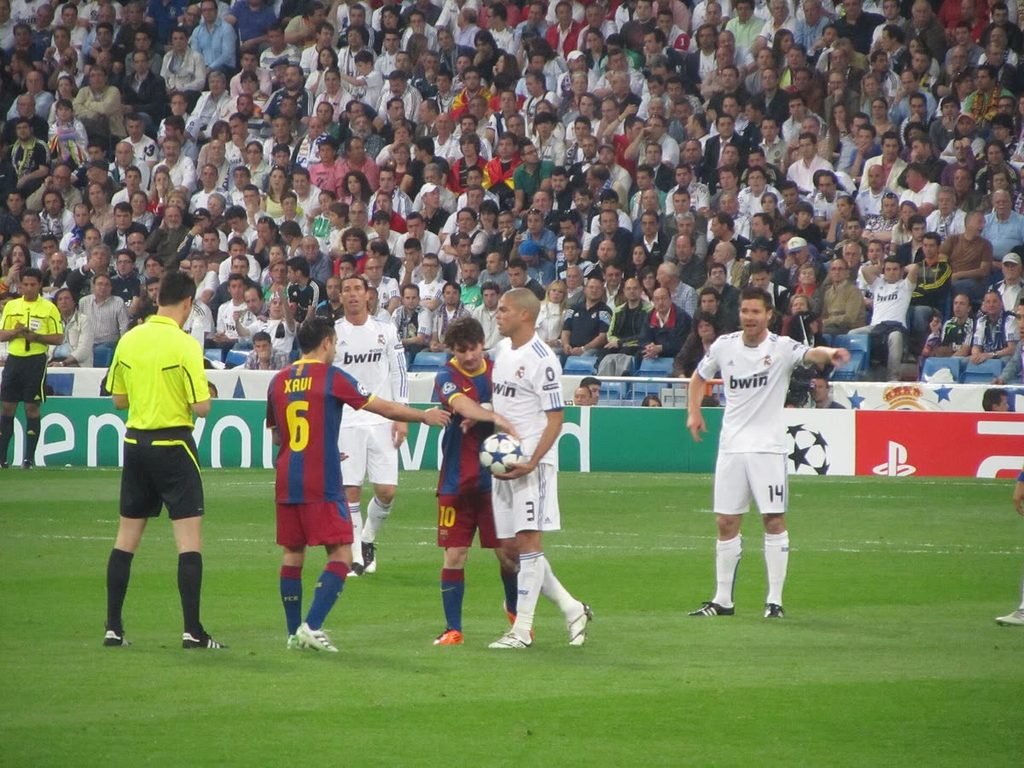
Then came Pep Guardiola and José Mourinho, and the fixture became a war between two ideas of how the game should be played. Barcelona won 5-0 at the Camp Nou in November 2010. In the spring of 2011, the clubs met four times in eighteen days, and Cristiano Ronaldo’s header won Madrid the Copa del Rey final in extra time. The tension spilled into touchline fights and press conferences that felt like diplomatic incidents.
And underneath it all ran the greatest individual rivalry the sport has ever seen. Lionel Messi and Cristiano Ronaldo spent nine seasons in the same league, in the same fixture, pushing each other to numbers that should not be possible. Every Clásico became a vote on who was the best player in the world, and the whole planet got a ballot.
Why El Clásico Will Never Be Just a Game
So here is my verdict, from the Madrid side of the line.
Real Madrid is the greatest club in the history of football, and the trophy cabinet backs that up. But this rivalry made us greater. Without Barcelona, Madrid would have had nobody worth proving anything to. Without Madrid, Barcelona would have had nothing to define itself against. The hostility is real. So is the need for each other.
El Clásico was never just about football because it was never really about ninety minutes. It is about a king’s crown on one badge and a nation’s flag in the other’s colours. It is about 1943 and 1953, about Sunyol and Di Stéfano, about Cruyff’s choice and Figo’s crossing. Every time these two teams meet, all of that walks out of the tunnel with them.
That is why I will always represent my side. And that is why I will always respect the other one. A rivalry without a worthy opponent is just a grudge. This one has never been short of either.
Your turn. Pick your side.
The debate
No arguments yet. Start one.
Argue hard, respect the other side. Attack the argument, never the person. Comments that cross that line get removed.