

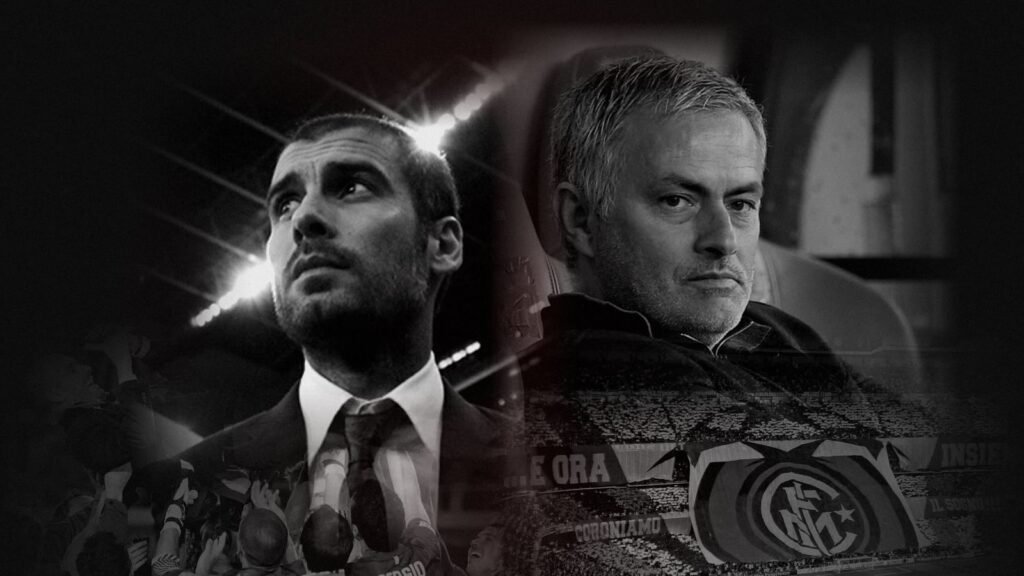
In May 2026, Pep Guardiola told Manchester City he was leaving. Ten years, twenty trophies, and one sentence that said everything: deep inside, he knew it was his time. Three weeks later, José Mourinho was named manager of Real Madrid for the second time.
One walked away from football. The other walked back into the Bernabéu. That is how Guardiola vs Mourinho looks in 2026, and it tells you most of what you need to know about both men.
I watched most of this war from the Madrid end, so I am not neutral, and I will not pretend to be. But I owe the other side the truth, and the truth about these two is more interesting than either set of fans likes to admit.
1996: The Same Dressing Room
They started on the same side. In 1996, Bobby Robson arrived at Barcelona with a young Portuguese assistant who translated for him and soon did a great deal more. His name was José Mourinho. The team’s midfield general, and from 1997 its captain, was Pep Guardiola. Mourinho stayed four years, under Robson and then Louis van Gaal, planning training sessions and talking football with the players.
For four years they worked on the same pitch, for the same club. Two football obsessives, one in boots and one with a notebook. Neither could have guessed what they would become to each other.
2008: The Job Barcelona Gave to the Other Man
In 2008, Barcelona needed a new manager. Mourinho wanted the job, and he had earned the right to ask. In 2004 he had won the Champions League with Porto, a club nobody had picked to win it, and then two league titles in a row with Chelsea. Barcelona gave the job to Guardiola, who had managed only their B team, for a single season.
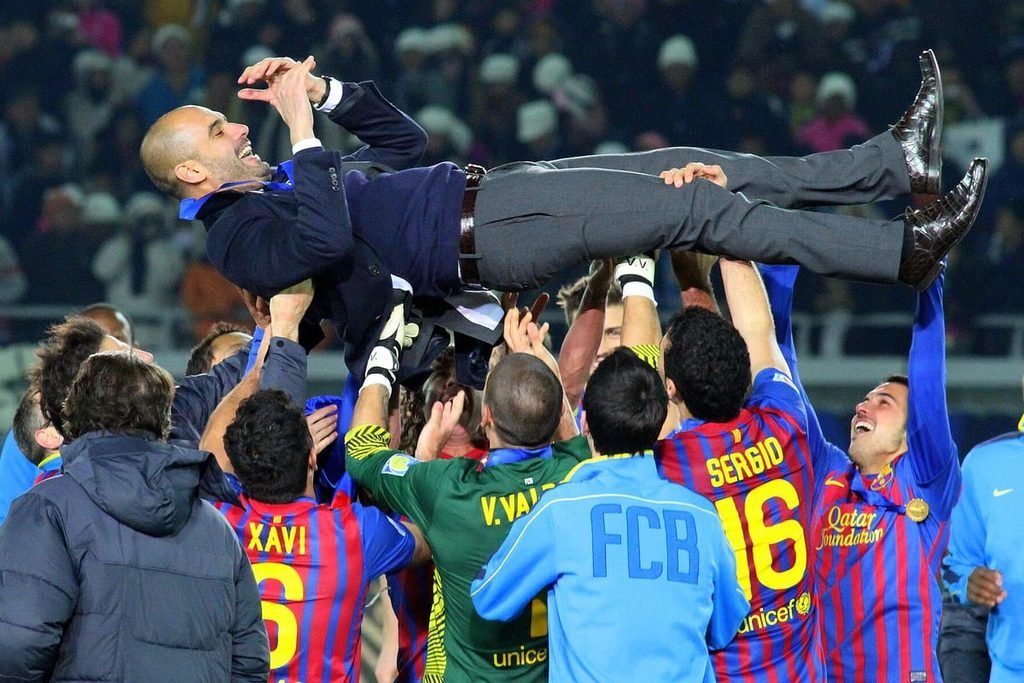
It was the right decision. Guardiola won the treble in his first season, six trophies in a single calendar year and fourteen in four seasons. But a rejection like that does not disappear. Mourinho went to Inter instead, and within two years he had his answer ready.
2010: The Sprinklers
April 2010, the Champions League semi-final. Mourinho’s Inter beat Guardiola’s Barcelona 3-1 in Milan, then went to the Camp Nou and defended that lead with ten men for more than an hour. Barcelona won 1-0 on the night and went out 3-2 on aggregate. Mourinho ran across the pitch with his finger in the air while the ground staff turned the sprinklers on. He called it the most beautiful defeat of his life.
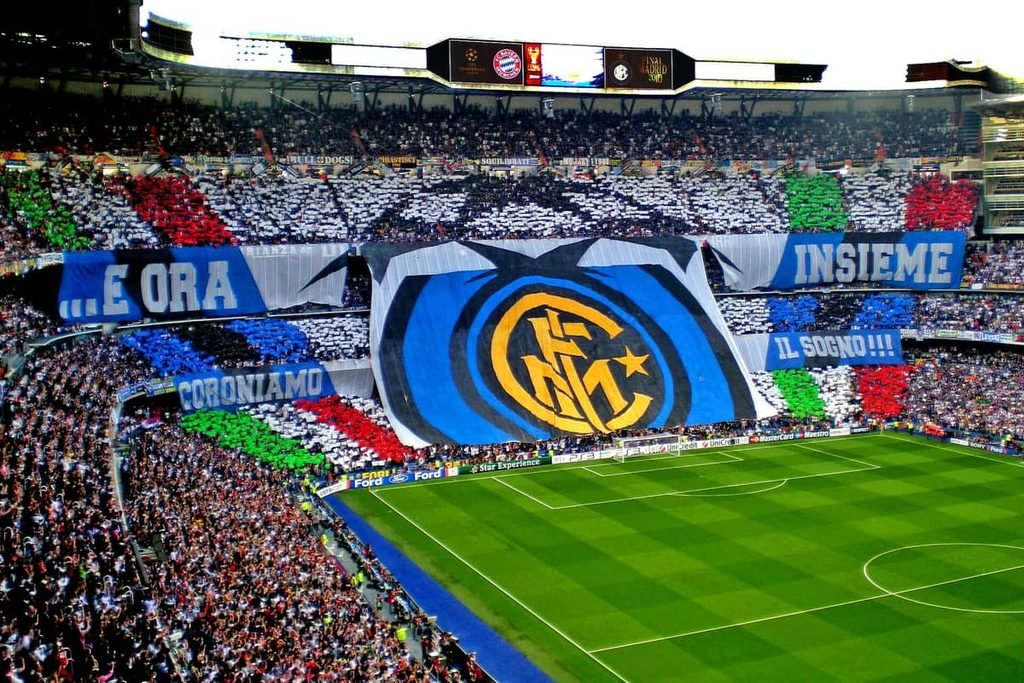
Less than a month later, at the Bernabéu of all places, Inter beat Bayern Munich 2-0 in the final. It was Inter’s first European Cup in 45 years, and the first treble any Italian club had ever won. Twice now, Mourinho had taken a team nobody believed in and made it champion of Europe. That is something Guardiola, for all his trophies, has never had to do.
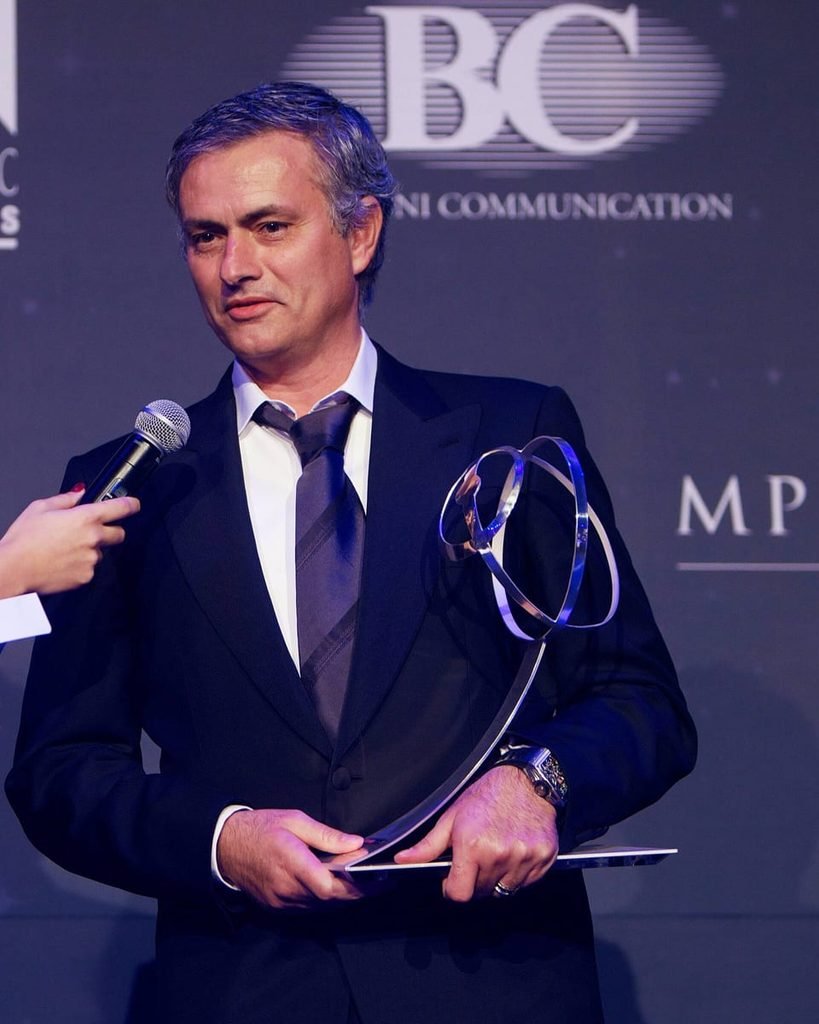
Days later he was Real Madrid’s manager. We had hired the one man who had proved Guardiola’s Barcelona could be beaten.
2011: Eighteen Days
The first Clásico of the war was a disaster for my side. In November 2010, Barcelona beat Mourinho’s Madrid 5-0. Then, in the spring of 2011, the two clubs met four times in eighteen days: once in the league, once in the Copa del Rey final and twice in the Champions League semi-final.
Madrid won the cup with a Cristiano Ronaldo header in extra time. Barcelona won the semi-final. And somewhere in those eighteen days, the football stopped being the main event. Mourinho needled Guardiola about referees. Guardiola, who almost never bit, finally did. Before the semi-final he told a press conference that in that room Mourinho was the boss, the master, and that he could not compete with him there. He would see him on the pitch. After the first leg, which Madrid lost with ten men, Mourinho went further and accused UEFA of favouring Barcelona.
That August, in a Super Cup match that ended in a brawl, Mourinho poked Barcelona’s assistant coach Tito Vilanova in the eye. As a Madrid fan, I did not enjoy watching that. It was the moment the war went too far.
2012: A Hundred Points
Then Mourinho won. In 2011-12, his Madrid took the league with 100 points and 121 goals, both Spanish records, and beat Barcelona 2-1 at the Camp Nou in April to settle it. Six days later, Guardiola announced he was leaving Barcelona. He said he was tired, and that four years there had felt like an eternity.
Mourinho did not beat Guardiola’s football. He exhausted it. That is the fairest summary of those two years I can give, and both sides should be able to live with it.
Mourinho did not beat Guardiola’s football. He exhausted it.
2016: Manchester
They met again in England, in the same city. Guardiola took Manchester City in 2016, Mourinho took Manchester United the same summer, and for a moment it looked like round two. It was not close. In 2017-18, City won the league with 100 points. United finished second, nineteen points behind.
There were sparks. After City won at Old Trafford in December 2017, a row in the tunnel left Mourinho soaked in milk and water and a City coach, Mikel Arteta, with a cut face. Four months later, United came from 2-0 down to win 3-2 at City and delay the title party. But by December 2018 Mourinho had been sacked, and Guardiola was on his way to four league titles in a row and a treble.
Twenty-Five Matches
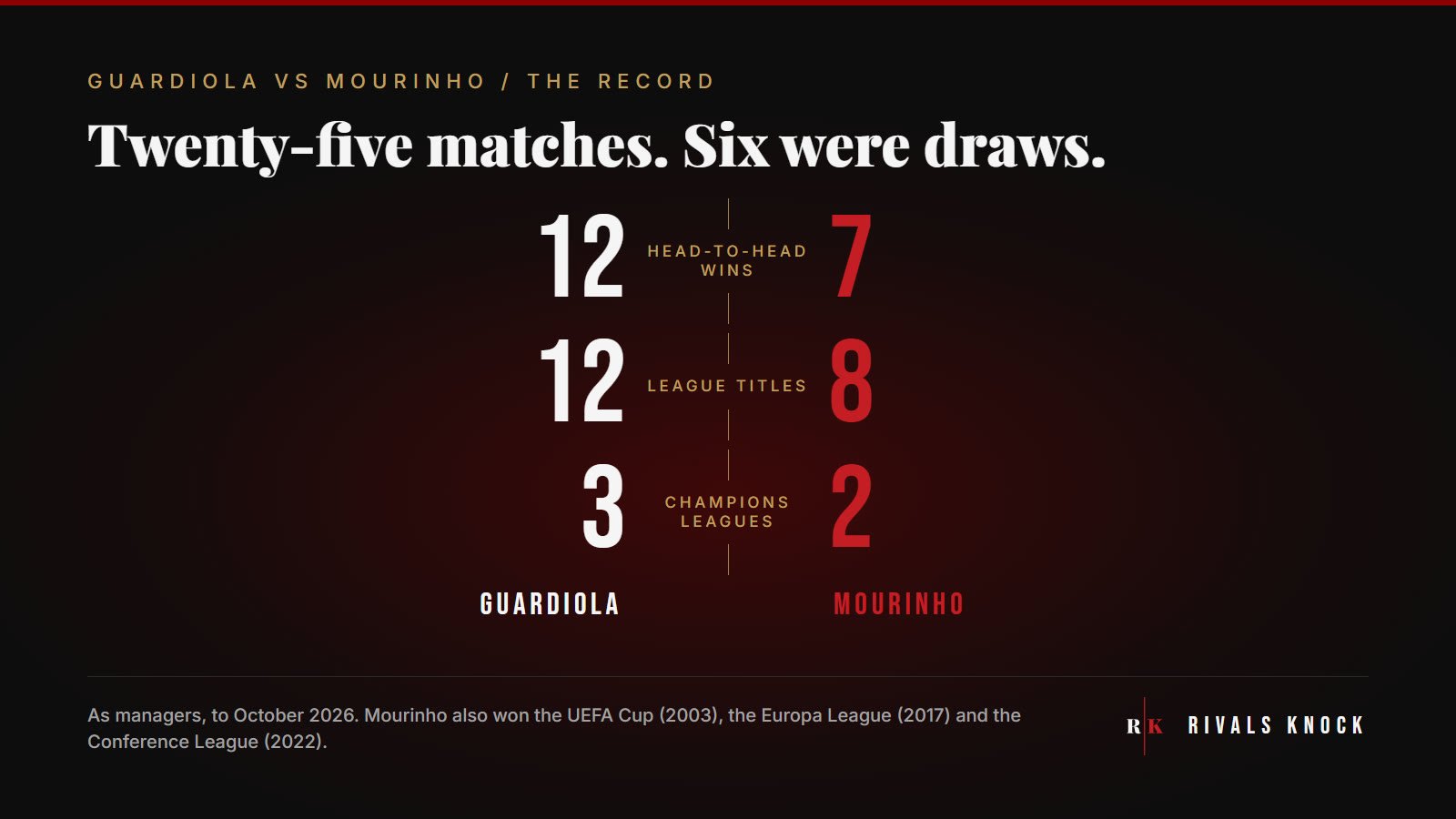
The full scorecard is not flattering to my side of the argument. They have faced each other 25 times as managers. Guardiola has won 12, Mourinho 7, and 6 were draws. Guardiola has twelve league titles in three countries and three Champions Leagues. Mourinho has eight league titles in four countries, two Champions Leagues, and European trophies with Porto, Inter, Manchester United and Roma.
And the generation they split? Look at the dugouts. Arteta, who learned at Guardiola’s side, built Arsenal into champions. Vincent Kompany and Enzo Maresca came out of the same school. On the other side stand Mourinho’s loyalists, like Álvaro Arbeloa, who managed Madrid before him. And then there is Xabi Alonso, who played for Mourinho at Madrid and for Guardiola at Bayern, and took something from both. Every young coach in Europe has had to decide which of these two men he believes.
2026: A Thank-You Note
The last twist came in January 2026. Mourinho, then at Benfica, needed one more goal against Real Madrid in the Champions League. In the 98th minute he sent his goalkeeper forward, and Anatoliy Trubin headed in to make it 4-2. That goal also saved Guardiola’s City from a play-off. Asked if he would send Mourinho a thank-you message, Guardiola said: ‘Yeah, of course.’
Thirty years after they shared a dressing room, the old enemies were doing each other favours. I am still not sure how I feel about the fact that it came at Madrid’s expense.
The Verdict on Guardiola vs Mourinho
It hurts to write this with Mourinho sitting in our dugout, but the record is the record. Guardiola won the war. More wins when they met, more league titles, more Champions Leagues, and an idea of football that half the coaches in Europe now copy. If the question is who was the greater manager, the answer is Guardiola.
But I will say this for Mourinho, and it is not a consolation prize. He is the only man who made Guardiola’s greatest team look beatable, and he did it twice, with Inter and with Madrid. He won the Champions League with clubs that had no business winning it. Without him, the Guardiola years would have been a procession, and football would have had one idea instead of two.
One of them has left the stage. The other is back at the Bernabéu with something still to prove. Guardiola won the argument. Mourinho is the one still making it.
Your turn. Pick your side.
The debate
No arguments yet. Start one.
Argue hard, respect the other side. Attack the argument, never the person. Comments that cross that line get removed.